
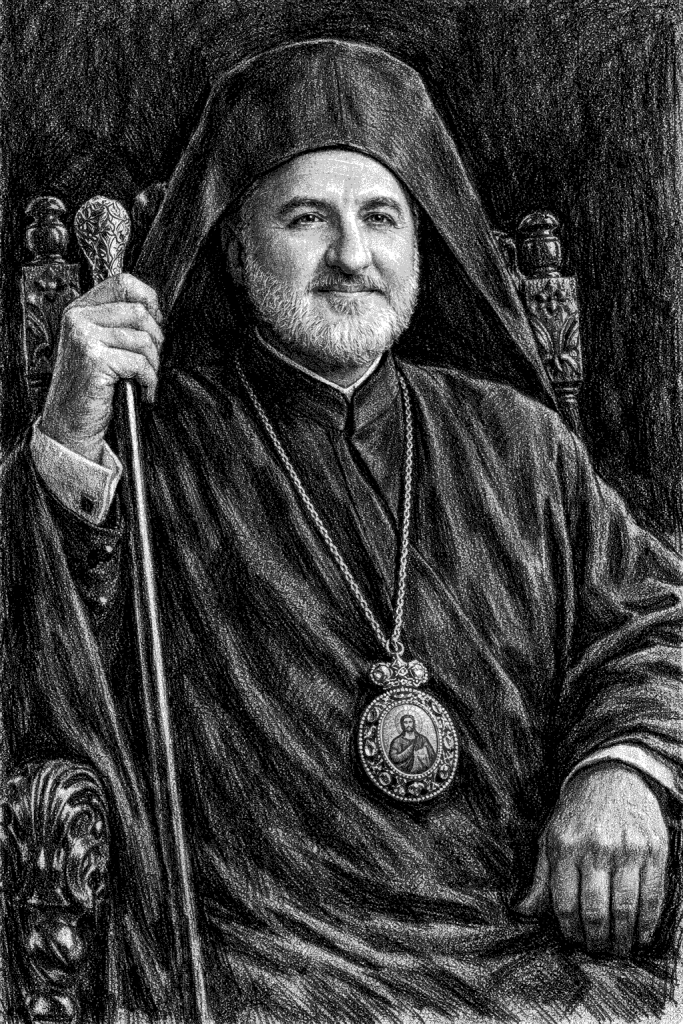
The Orthodox Observer published an article on 06 February 2026 entitled:
“Archbishop Elpidophoros unveils bold vision: a Greek university and a new cathedral for GOA”
What follows is an open answer to that article from a historic perspective by a non-ethnically Greek parish member of a GOA church.
The first proposal presented by His Eminence Elpidophoros was for the establishment of the first Greek university in the United States,” He stated that “we have a school for 90 years [located at] the educational Athens of the world, in Boston,”
The second proposal was to purchase an historic, Episcopal church, St. Bartholomew’s and to move the arch-episcopal cathedral there, characterizing St. Bartholomew’s as “featuring richly Byzantine-inspired architecture” . The article called St. Bartholomew’s a ” landmark Byzantine-style Episcopal church at 325 Park Avenue”.
The first proposal to create the first Greek University in the United States is justified by holding up the example of the seminary of Balamand in Lebanon which was built from the seminary and monastery of Balamand. The first Orthodox University of America was the University of St. Katherine which fell into bankruptcy and ceased operation in 2024. As for Boston being the educational Athens of the world, the meaning of that assertion is unclear. The greater Boston area hosts 24 universities and colleges but none are ranked among the top 100 universities in America. Nine Massachusetts universities are in the top 100 universities of American. The article does not explain what would make the proposed university Greek and curriculum was not mentioned. Most American Orthodox Seminaries only offer certificates of study or post-graduate degrees, with the exception of Holy Trinity (ROCOR) and St. Hermans (OCA) which each offer a bachelor’s degree in one religious field of study. Perhaps what is proposed is a 4 year university with coursework that emphasis Greek studies. The proposal also did not seem to indicate the target student body or institutional goals.
One thing is certain, Greek language, arts, science and cultural values formed the basis for Western civilization. The entire New Testament bears witness to every Christian’s Greek legacy, even those of other non-Greek jurisdictions. The first chapter of John draws on the philosophy of the Hellenistic Jew, Philo of Alexandria and his synthesis of logos with Hebrew scripture. The conquests of Alexander the Great provided Greek as the “lingua franca” of the antique period and a fertile field of precise language and philosophical thought. The contributions of the Greeks to civilization and faith is inestimable.
Today, more Orthodox works of every language (i.e. Greek, Syriac, Slavonic, Georgian, Romainian, etc.) are available in English than in any other language at any other time. So English itself has become a lingua franca in modern orthodoxy. We are witness to a burgeoning worldwide evangelization that has North America as a major growth nexus. The study of classical Greek was a key element of classical European learning. American public and private schools, including Universities favor novel ideas over classicism. It is definitely time for a University with a focus on Greek studies in North America though Boston is definitely not the center of academics. Just saying.
The article portrays the second proposal as a necessity for additional space with the historical significance of the new site as a key positive aspect highlighting the Greek influence of the architecture. His Eminence went on to state, “Symbols matter in this country and in every country. This will make our Church one of the mainstream churches in the United States, respected and accepted by everyone.”
While a larger cathedral and additional space are legitimate needs and making provisions for those needs are honorable, the assertion that acquiring a property no longer used by a magisterial reformation denomination which has demonstrated it’s irrelevance by driving off so many of it’s former adherents to the point where it must abandon it’s church buildings as there aren’t sufficient parishioners to support them defies reason. It begs credulity to believe that acquiring their abandoned historic structures will provide the Greek Orthodox American Arch-Diocese with a “symbol” that will “finally make our Church one of the mainstream churches in the United States, respected and accepted by everyone.” (Who knew that what was missing was a symbol?) These empty houses of worship reveal the irrelevance and spiritual vapidity that their church leadership foisted upon them. In reality by trading the Holy Spirit and sacred tradition for zeitgeist in order to find modern relevance led to the abandonment of their very raison d’etre which was inevitably followed by their demise. The structures stand as witness to a mad self-destruction. They are not a symbol of respectability. If indeed there is some lack of acceptance of the Greek Church by American society it is not because it has failed to conform to the outward image of failed and discredited institutions. The perception that the Greek Orthodox Church is not accepted in America is not reflected by the numbers of the former adherents of the magisterial reformation churches flocking to the Greek Orthodox parishes. What is not accepted are the strange and perverse practices and beliefs deemed acceptable by church leaders that have nearly driven the magisterial reformation churches out of existence. If other church leader follows similar beliefs and practices then they should have no delusions as to where that leads. Been there. Seen that. Bought the building.
Citing a civil rights march that happened 60 years ago, when Archbishop was two years old, as the last time the Greek Orthodox Church placed itself at the center of American life seems a sad commentary on the condition of the church, if such was ever a legitimate pursuit. Our progress is not the measure of our societal acceptance or the headlines we can grab but rather the harvest we reap, the extent to which we share the Gospel and thereby transform lives and through those lives God’s creation & society; Fishers of men, not likes, not headlines.
In the past century some of the Orthodox jurisdictions in North America adopted practices and dress in an attempt to appear more “acceptable” to Americans. They mandated Episcopalian suits and collars for clergy use outside church sanctuaries. They mandated short hair and clean-shaven faces or closely cropped beards, deeming long hair and long beards to be culturally repulsive. In fact, a now reposed Metropolitan actually deposed one of his bishops on the grounds that he appeared in a cassock outside of his own cathedral! Some jurisdictions installed pews, organs and even adopted modern American liturgical compositions instead of Byzantine works. Some of these “Americanizations” have been relaxed in the present century yet others remain. It is the traditional Byzantine chant that draws newcomers, not Hollywood compositions and Episcopalian mimicry. Converts simply do not want things that remind them of that which they fled. It is authenticity and genuine spiritual growth that they seek and that is the key to spiritual relevance, not the spirit of the world, the spirit of the age. Orthodox hierarchs should seek spiritual authenticity as they faithfully dispense the Word of Truth, not the cultural acceptance of a lost society .
His Eminence answered a question about the influx of converts to the Greek church. He answered very well about most points. He even mentioned the discussions by the Assembly of Canonical Orthodox Bishops of the United States about a unified catechesis and a catechist training program. However, he then went on to propose a program to be developed by the Greek Orthodox Archdiocese. The need for a unified course and training underscores the need for the unity of the Assembly of Canonical Orthodox Bishops of the United States rather than an individual jurisdictional approach. Either there is a unity of faith in Orthodoxy or there is not. Even if our jurisdictions remain separate administrations that should be the extent of the separation, at least as much as present conditions permit. Each jurisdiction will develop it’s own publications but the variances should not be on matters of belief, doctrine or dogma. This requires patience, care, coordination and concilliarity
One final note, all of the persons quoted in the article had Greek surnames. That will likely not last long given current trends and extant demographics. The converts were attracted by what they saw and experienced but it was the Holy Spirit who brought them to our doorsteps. We need to care for that which has been entrusted to us. We may have plans but God has His own.
With your prayers.