
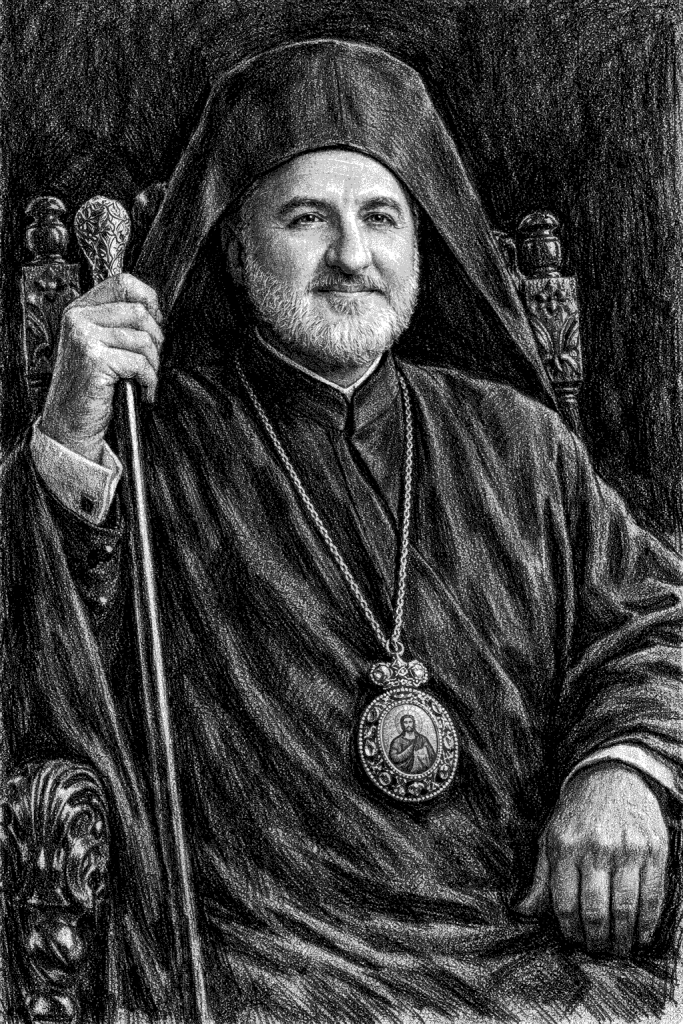
Open Answer To Archbishop Elpidophoros’ Bold Vision

The Orthodox Observer published an article on 06 February 2026 entitled:

“Archbishop Elpidophoros unveils bold vision: a Greek university and a new cathedral for GOA”

What follows is an open answer to that article from a historic perspective by a non-ethnically Greek parish member of a GOA church.

The first proposal presented by His Eminence Elpidophoros was for the establishment of the first Greek university in the United States,” He stated that “we have a school for 90 years [located at] the educational Athens of the world, in Boston,”

The second proposal was to purchase an historic, Episcopal church, St. Bartholomew’s and to move the arch-episcopal cathedral there, characterizing St. Bartholomew’s as “featuring richly Byzantine-inspired architecture” . The article called St. Bartholomew’s a ” landmark Byzantine-style Episcopal church at 325 Park Avenue”.

The first proposal to create the first Greek University in the United States is justified by holding up the example of the seminary of Balamand in Lebanon which was built from the seminary and monastery of Balamand. The first Orthodox University of America was the University of St. Katherine which fell into bankruptcy and ceased operation in 2024. As for Boston being the educational Athens of the world, the meaning of that assertion is unclear. The greater Boston area hosts 24 universities and colleges but none are ranked among the top 100 universities in America. Nine Massachusetts universities are in the top 100 universities of American. The article does not explain what would make the proposed university Greek and curriculum was not mentioned. Most American Orthodox Seminaries only offer certificates of study or post-graduate degrees, with the exception of Holy Trinity (ROCOR) and St. Hermans (OCA) which each offer a bachelor’s degree in one religious field of study. Perhaps what is proposed is a 4 year university with coursework that emphasis Greek studies. The proposal also did not seem to indicate the target student body or institutional goals.

One thing is certain, Greek language, arts, science and cultural values formed the basis for Western civilization. The entire New Testament bears witness to every Christian’s Greek legacy, even those of other non-Greek jurisdictions. The first chapter of John draws on the philosophy of the Hellenistic Jew, Philo of Alexandria and his synthesis of logos with Hebrew scripture. The conquests of Alexander the Great provided Greek as the “lingua franca” of the antique period and a fertile field of precise language and philosophical thought. The contributions of the Greeks to civilization and faith is inestimable.

Today, more Orthodox works of every language (i.e. Greek, Syriac, Slavonic, Georgian, Romainian, etc.) are available in English than in any other language at any other time. So English itself has become a lingua franca in modern orthodoxy. We are witness to a burgeoning worldwide evangelization that has North America as a major growth nexus. The study of classical Greek was a key element of classical European learning. American public and private schools, including Universities favor novel ideas over classicism. It is definitely time for a University with a focus on Greek studies in North America though Boston is definitely not the center of academics. Just saying.

The article portrays the second proposal as a necessity for additional space with the historical significance of the new site as a key positive aspect highlighting the Greek influence of the architecture. His Eminence went on to state, “Symbols matter in this country and in every country. This will make our Church one of the mainstream churches in the United States, respected and accepted by everyone.”

While a larger cathedral and additional space are legitimate needs and making provisions for those needs are honorable, the assertion that acquiring a property no longer used by a magisterial reformation denomination which has demonstrated it’s irrelevance by driving off so many of it’s former adherents to the point where it must abandon it’s church buildings as there aren’t sufficient parishioners to support them defies reason. It begs credulity to believe that acquiring their abandoned historic structures will provide the Greek Orthodox American Arch-Diocese with a “symbol” that will “finally make our Church one of the mainstream churches in the United States, respected and accepted by everyone.” (Who knew that what was missing was a symbol?) These empty houses of worship reveal the irrelevance and spiritual vapidity that their church leadership foisted upon them. In reality by trading the Holy Spirit and sacred tradition for zeitgeist in order to find modern relevance led to the abandonment of their very raison d’etre which was inevitably followed by their demise. The structures stand as witness to a mad self-destruction. They are not a symbol of respectability. If indeed there is some lack of acceptance of the Greek Church by American society it is not because it has failed to conform to the outward image of failed and discredited institutions. The perception that the Greek Orthodox Church is not accepted in America is not reflected by the numbers of the former adherents of the magisterial reformation churches flocking to the Greek Orthodox parishes. What is not accepted are the strange and perverse practices and beliefs deemed acceptable by church leaders that have nearly driven the magisterial reformation churches out of existence. If other church leader follows similar beliefs and practices then they should have no delusions as to where that leads. Been there. Seen that. Bought the building.

Citing a civil rights march that happened 60 years ago, when Archbishop was two years old, as the last time the Greek Orthodox Church placed itself at the center of American life seems a sad commentary on the condition of the church, if such was ever a legitimate pursuit. Our progress is not the measure of our societal acceptance or the headlines we can grab but rather the harvest we reap, the extent to which we share the Gospel and thereby transform lives and through those lives God’s creation & society; Fishers of men, not likes, not headlines.

In the past century some of the Orthodox jurisdictions in North America adopted practices and dress in an attempt to appear more “acceptable” to Americans. They mandated Episcopalian suits and collars for clergy use outside church sanctuaries. They mandated short hair and clean-shaven faces or closely cropped beards, deeming long hair and long beards to be culturally repulsive. In fact, a now reposed Metropolitan actually deposed one of his bishops on the grounds that he appeared in a cassock outside of his own cathedral! Some jurisdictions installed pews, organs and even adopted modern American liturgical compositions instead of Byzantine works. Some of these “Americanizations” have been relaxed in the present century yet others remain. It is the traditional Byzantine chant that draws newcomers, not Hollywood compositions and Episcopalian mimicry. Converts simply do not want things that remind them of that which they fled. It is authenticity and genuine spiritual growth that they seek and that is the key to spiritual relevance, not the spirit of the world, the spirit of the age. Orthodox hierarchs should seek spiritual authenticity as they faithfully dispense the Word of Truth, not the cultural acceptance of a lost society .

His Eminence answered a question about the influx of converts to the Greek church. He answered very well about most points. He even mentioned the discussions by the Assembly of Canonical Orthodox Bishops of the United States about a unified catechesis and a catechist training program. However, he then went on to propose a program to be developed by the Greek Orthodox Archdiocese. The need for a unified course and training underscores the need for the unity of the Assembly of Canonical Orthodox Bishops of the United States rather than an individual jurisdictional approach. Either there is a unity of faith in Orthodoxy or there is not. Even if our jurisdictions remain separate administrations that should be the extent of the separation, at least as much as present conditions permit. Each jurisdiction will develop it’s own publications but the variances should not be on matters of belief, doctrine or dogma. This requires patience, care, coordination and concilliarity

One final note, all of the persons quoted in the article had Greek surnames. That will likely not last long given current trends and extant demographics. The converts were attracted by what they saw and experienced but it was the Holy Spirit who brought them to our doorsteps. We need to care for that which has been entrusted to us. We may have plans but God has His own.

With your prayers.

Isaac Of Ninevah – Spiritual Discourses

In 1984 a Eastern Syriac Manuscript called “Spiritual Discourses and Other Works Of Mar Isaac of Ninevah” was found in the British Library. In 1994 the first four chapters were translated into Italian by P. Bettolio and subsequently the remaining chapters were translated in various languages including English. The English version of the second part is available as ISBN-13# 978-9068317091.

I found a copy of the first part in Italian at Zlibrary. I used a machine translation and given my limited knowledge of Italian and knowledge of Spanish corrected it as best I could.

The scholarly consensus seems to favor this as an authentic, heretofore unknown, work of St. Isaac of Ninevah subsequent to his well known work, The Spiritual Homilies.

Linux Dark Terminal ~/.dircolors

# Configuration file for dircolors, a utility to help you set the
# LS_COLORS environment variable used by GNU ls with the --color option.
# Copyright (C) 1996-2023 Free Software Foundation, Inc.
# Copying and distribution of this file, with or without modification,
# are permitted provided the copyright notice and this notice are preserved.
#
# The keywords COLOR, OPTIONS, and EIGHTBIT (honored by the
# slackware version of dircolors) are recognized but ignored.
# Global config options can be specified before TERM or COLORTERM entries
# ===================================================================
# Terminal filters
# ===================================================================
# Below are TERM or COLORTERM entries, which can be glob patterns, which
# restrict following config to systems with matching environment variables.
COLORTERM ?*
TERM Eterm
TERM ansi
TERM *color*
TERM con[0-9]*x[0-9]*
TERM cons25
TERM console
TERM cygwin
TERM *direct*
TERM dtterm
TERM gnome
TERM hurd
TERM jfbterm
TERM konsole
TERM kterm
TERM linux
TERM linux-c
TERM mlterm
TERM putty
TERM rxvt*
TERM screen*
TERM st
TERM terminator
TERM tmux*
TERM vt100
TERM xterm*
# ===================================================================
# Basic file attributes
# ===================================================================
# Below are the color init strings for the basic file types.
# One can use codes for 256 or more colors supported by modern terminals.
# The default color codes use the capabilities of an 8 color terminal
# with some additional attributes as per the following codes:
# Attribute codes:
# 00=none 01=bold 04=underscore 05=blink 07=reverse 08=concealed
# Text color codes:
# 30=black 31=red 32=green 33=yellow 34=blue 35=magenta 36=cyan 37=white
# Background color codes:
# 40=black 41=red 42=green 43=yellow 44=blue 45=magenta 46=cyan 47=white
#NORMAL 00 # no color code at all
#FILE 00 # regular file: use no color at all
RESET 0 # reset to "normal" color
DIR 01;96 # directory
LINK 01;36 # symbolic link. (If you set this to 'target' instead of a
 # numerical value, the color is as for the file pointed to.)
MULTIHARDLINK 00 # regular file with more than one link
FIFO 40;33 # pipe
SOCK 01;35 # socket
DOOR 01;35 # door
BLK 40;33;01 # block device driver
CHR 40;33;01 # character device driver
ORPHAN 40;31;01 # symlink to nonexistent file, or non-stat'able file ...
MISSING 00 # ... and the files they point to
SETUID 37;41 # file that is setuid (u+s)
SETGID 30;43 # file that is setgid (g+s)
CAPABILITY 00 # file with capability (very expensive to lookup)
STICKY_OTHER_WRITABLE 30;42 # dir that is sticky and other-writable (+t,o+w)
OTHER_WRITABLE 34;42 # dir that is other-writable (o+w) and not sticky
STICKY 37;44 # dir with the sticky bit set (+t) and not other-writable
# This is for files with execute permission:
EXEC 01;32
# ===================================================================
# File extension attributes
# ===================================================================
# List any file extensions like '.gz' or '.tar' that you would like ls
# to color below. Put the suffix, a space, and the color init string.
# (and any comments you want to add after a '#').
# Suffixes are matched case insensitively, but if you define different
# init strings for separate cases, those will be honored.
#
# If you use DOS-style suffixes, you may want to uncomment the following:
#.cmd 01;32 # executables (bright green)
#.exe 01;32
#.com 01;32
#.btm 01;32
#.bat 01;32
# Or if you want to color scripts even if they do not have the
# executable bit actually set.
#.sh 01;32
#.csh 01;32
# archives or compressed (bright red)
.tar 01;31
.tgz 01;31
.arc 01;31
.arj 01;31
.taz 01;31
.lha 01;31
.lz4 01;31
.lzh 01;31
.lzma 01;31
.tlz 01;31
.txz 01;31
.tzo 01;31
.t7z 01;31
.zip 01;31
.z 01;31
.dz 01;31
.gz 01;31
.lrz 01;31
.lz 01;31
.lzo 01;31
.xz 01;31
.zst 01;31
.tzst 01;31
.bz2 01;31
.bz 01;31
.tbz 01;31
.tbz2 01;31
.tz 01;31
.deb 01;31
.rpm 01;31
.jar 01;31
.war 01;31
.ear 01;31
.sar 01;31
.rar 01;31
.alz 01;31
.ace 01;31
.zoo 01;31
.cpio 01;31
.7z 01;31
.rz 01;31
.cab 01;31
.wim 01;31
.swm 01;31
.dwm 01;31
.esd 01;31
# image formats
.avif 01;35
.jpg 01;35
.jpeg 01;35
.mjpg 01;35
.mjpeg 01;35
.gif 01;35
.bmp 01;35
.pbm 01;35
.pgm 01;35
.ppm 01;35
.tga 01;35
.xbm 01;35
.xpm 01;35
.tif 01;35
.tiff 01;35
.png 01;35
.svg 01;35
.svgz 01;35
.mng 01;35
.pcx 01;35
.mov 01;35
.mpg 01;35
.mpeg 01;35
.m2v 01;35
.mkv 01;35
.webm 01;35
.webp 01;35
.ogm 01;35
.mp4 01;35
.m4v 01;35
.mp4v 01;35
.vob 01;35
.qt 01;35
.nuv 01;35
.wmv 01;35
.asf 01;35
.rm 01;35
.rmvb 01;35
.flc 01;35
.avi 01;35
.fli 01;35
.flv 01;35
.gl 01;35
.dl 01;35
.xcf 01;35
.xwd 01;35
.yuv 01;35
.cgm 01;35
.emf 01;35
# https://wiki.xiph.org/MIME_Types_and_File_Extensions
.ogv 01;35
.ogx 01;35
# audio formats
.aac 00;36
.au 00;36
.flac 00;36
.m4a 00;36
.mid 00;36
.midi 00;36
.mka 00;36
.mp3 00;36
.mpc 00;36
.ogg 00;36
.ra 00;36
.wav 00;36
# https://wiki.xiph.org/MIME_Types_and_File_Extensions
.oga 00;36
.opus 00;36
.spx 00;36
.xspf 00;36
# backup files
*~ 00;90
*# 00;90
.bak 00;93
.crdownload 00;90
.dpkg-dist 00;90
.dpkg-new 00;90
.dpkg-old 00;90
.dpkg-tmp 00;90
.old 00;90
.orig 00;90
.part 00;90
.rej 00;90
.rpmnew 00;90
.rpmorig 00;90
.rpmsave 00;90
.swp 00;90
.tmp 00;93
.ucf-dist 00;90
.ucf-new 00;90
.ucf-old 00;90
#
# Subsequent TERM or COLORTERM entries, can be used to add / override
# config specific to those matching environment variables.

Linux Dark Terminal color preferences ~/.bashrc

# ~/.bashrc: executed by bash(1) for non-login shells.
# see /usr/share/doc/bash/examples/startup-files (in the package bash-doc)
# for examples

# If not running interactively, don't do anything
case $- in
    *i*) ;;
      *) return;;
esac

# don't put duplicate lines or lines starting with space in the history.
# See bash(1) for more options
HISTCONTROL=ignoreboth

# append to the history file, don't overwrite it
shopt -s histappend

# for setting history length see HISTSIZE and HISTFILESIZE in bash(1)
HISTSIZE=1000
HISTFILESIZE=2000

# check the window size after each command and, if necessary,
# update the values of LINES and COLUMNS.
shopt -s checkwinsize

# If set, the pattern "**" used in a pathname expansion context will
# match all files and zero or more directories and subdirectories.
#shopt -s globstar

# make less more friendly for non-text input files, see lesspipe(1)
[ -x /usr/bin/lesspipe ] && eval "$(SHELL=/bin/sh lesspipe)"

# set variable identifying the chroot you work in (used in the prompt below)
if [ -z "${debian_chroot:-}" ] && [ -r /etc/debian_chroot ]; then
    debian_chroot=$(cat /etc/debian_chroot)
fi

# set a fancy prompt (non-color, unless we know we "want" color)
case "$TERM" in
    xterm-color|*-256color) color_prompt=yes;;
esac

# uncomment for a colored prompt, if the terminal has the capability; turned
# off by default to not distract the user: the focus in a terminal window
# should be on the output of commands, not on the prompt
force_color_prompt=yes

if [ -n "$force_color_prompt" ]; then
    if [ -x /usr/bin/tput ] && tput setaf 1 >&/dev/null; then
	# We have color support; assume it's compliant with Ecma-48
	# (ISO/IEC-6429). (Lack of such support is extremely rare, and such
	# a case would tend to support setf rather than setaf.)
	color_prompt=yes
    else
	color_prompt=
    fi
fi

if [ "$color_prompt" = yes ]; then
    PS1='${debian_chroot:+($debian_chroot)}\[\033[01;92m\]\u@\h\[\033[00m\]:\[\033[01;96m\]\w\[\033[00m\]\$ '
else
    PS1='${debian_chroot:+($debian_chroot)}\u@\h:\w\$ '
fi
unset color_prompt force_color_prompt

# If this is an xterm set the title to user@host:dir
case "$TERM" in
xterm*|rxvt*)
    PS1="\[\e]0;${debian_chroot:+($debian_chroot)}\u@\h: \w\a\]$PS1"
    ;;
*)
    ;;
esac

# enable color support of ls and also add handy aliases
if [ -x /usr/bin/dircolors ]; then
    test -r ~/.dircolors && eval "$(dircolors -b ~/.dircolors)" || eval "$(dircolors -b)"
    alias ls='ls --color=auto'
    #alias dir='dir --color=auto'
    #alias vdir='vdir --color=auto'

    alias grep='grep --color=auto'
    alias fgrep='fgrep --color=auto'
    alias egrep='egrep --color=auto'
fi

# colored GCC warnings and errors
export GCC_COLORS='error=01;31:warning=01;35:note=01;36:caret=01;32:locus=01:quote=01'

# some more ls aliases
alias ll='ls -alF'
alias la='ls -A'
alias l='ls -CF'
alias now='date +%H%M:%d:%m:%Y'
alias dallas='TZ=America/Chicago now'
# Add an "alert" alias for long running commands.  Use like so:
#   sleep 10; alert
alias alert='notify-send --urgency=low -i "$([ $? = 0 ] && echo terminal || echo error)" "$(history|tail -n1|sed -e '\''s/^\s*[0-9]\+\s*//;s/[;&|]\s*alert$//'\'')"'

# Alias definitions.
# You may want to put all your additions into a separate file like
# ~/.bash_aliases, instead of adding them here directly.
# See /usr/share/doc/bash-doc/examples in the bash-doc package.

if [ -f ~/.bash_aliases ]; then
    . ~/.bash_aliases
fi

# enable programmable completion features (you don't need to enable
# this, if it's already enabled in /etc/bash.bashrc and /etc/profile
# sources /etc/bash.bashrc).
if ! shopt -oq posix; then
  if [ -f /usr/share/bash-completion/bash_completion ]; then
    . /usr/share/bash-completion/bash_completion
  elif [ -f /etc/bash_completion ]; then
    . /etc/bash_completion
  fi
fi
export SSH_AUTH_SOCK=$(gpgconf --list-dirs agent-ssh-socket)
gpgconf --launch gpg-agent


zfs snapshot script(s)

here is a zfs snapshot script that keys off of scriptname

#!/usr/bin/bash
#
# vmsnaps.sh - make snapshots of all VM zfs
# 	no calling args.  linked filename invoking script \
# 	determines behavior.  zfs snapshots require root access
#
SCRIPTNAME=${0##*/}
DATETIME=`/usr/bin/date +%H%M-%d-%m-%Y`
ROOTSNAPS='rpool rpool/ROOT rpool/ROOT/oicuraqt rpool/Shotwell rpool/USERDATA  rpool/USERDATA/luser rpool/USERDATA/luser2 rpool/USERDATA/root'
VMSNAPS=`zfs list |grep VM|awk '{printf(" "$1)}'`
ALLSNAPS=`zfs list -t snap 2>/dev/null|grep -v MOUNTPOINT|awk '{printf(" "$1)}'`

function rootsnaps() {
	for ROOT in ${ROOTSNAPS}
		do
			echo snapshot ${ROOT}\@${DATETIME}
			sudo zfs snapshot ${ROOT}@${DATETIME}
		done
		}
function vmsnaps() {
	for VM in ${VMSNAPS}
		do
			echo snapshot ${VM}\@${DATETIME}
			sudo zfs snapshot ${VM}@${DATETIME}
		done
		}
function destroyAllSnaps() {

			if confirmDestroy; then
			    echo "luser chose YES. Destroying all existing snapshots..."
 	for ALLSNAP in ${ALLSNAPS}
                do	
			sudo zfs destroy ${ALLSNAP}
		done	
			else
    			echo "luser chose NO. Aborting destruction of all snapshots..."
			fi
		}
	
function confirmDestroy() {
    while true; do
        read -p "This will destroy ALL existing snapshots.\n Do you want to proceed? (YES/NO/CANCEL) " yn
        case $yn in
            [Yy]* ) return 0;;
            [Nn]* ) return 1;;
            [Cc]* ) exit;;
            * ) echo "Please answer YES, NO, or CANCEL.";;
        esac
    done
}

# main script begins
case ${SCRIPTNAME} in
	snaproots.sh)
		
		rootsnaps
		;;

	snapvms.sh)
	
		vmsnaps
		;;

	snapall.sh)

		rootsnaps
		vmsnaps
		;;

	destroyallsnaps.sh)

		destroyAllSnaps
		;;
	*)
		printf "\nValid scriptnames are snaproots.sh, snapvms.sh, snapall.sh or \n destroyallsnaps.sh \nPlease create symbolic link with one of theses names to snaps.sh\n"
		;;
esac